Meta Prompting
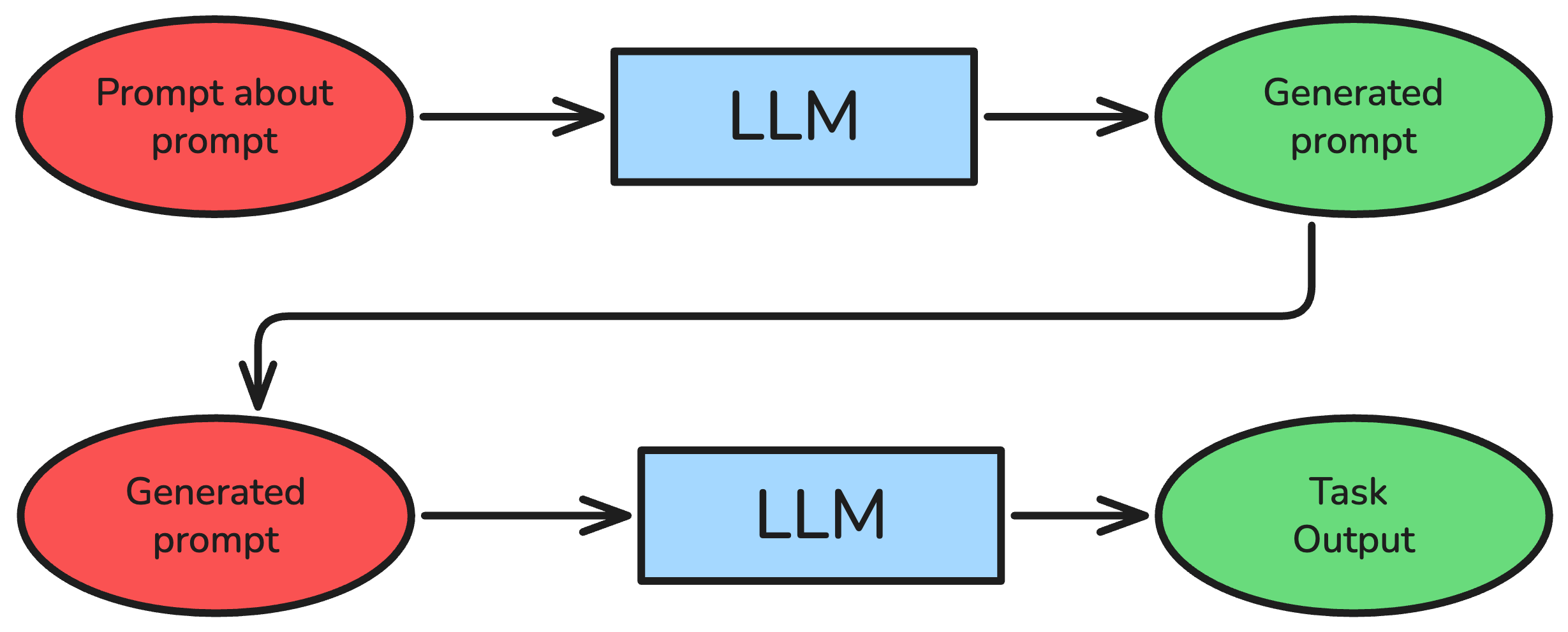
Uses one prompt to generate or refine another prompt, using the LLM to craft how to interact with it.
Problem
Prompt quality is a bottleneck; writing effective prompts directly is difficult and sensitive to wording details.
Solution
Use one prompt to generate, refine, select, or template another prompt. Separating intent specification from wording implementation makes prompt design faster, more consistent, and iteratively improvable.
Example
One worked example. The book has 2–4 per technique.
Write me a system prompt for a customer support assistant for a SaaS billing product.
It should help with billing issues like "charged twice," keep answers consistent, and know when to hand off to a human.
Keep it short and practical.
You are a customer support assistant for [Platform Name], focused on billing questions.

Rules:

* Ask for account email or account ID if missing. If you cannot access accounts, say so and collect what you need.
* Do not guess invoice details. Use account data when available.
* Explain billing in plain language, using the user's actual invoices, dates, and amounts when possible.
* For "charged twice," check for: duplicate subscriptions, plan changes (proration), payment retries, pending authorizations, multiple workspaces.
* Do not tell the user to contact their bank as a first step.
* Escalate to a human for suspected fraud, account takeover, or refunds over $500, or if unresolved after two exchanges.

Response structure:

1. What I need (only missing info)
2. What I found (most likely cause)
3. Next step (one specific action)

Tone: professional, calm, and direct.
Techniques
Concrete ways to implement Meta Prompting. Each technique fits a different situation.
- 01
Prompt Refinement
Take an existing draft prompt and ask the model to improve it, making requirements explicit and removing ambiguity.
- 02
Prompt Generation
Ask the model to create a new prompt from scratch given a description of the goal, target system, and constraints.
- 03
Prompt Selection
Generate multiple candidate prompts for the same task, test them, and select the one that performs best.
- 04
Prompt Templating
Generate a reusable prompt template that works across a category of similar tasks, leaving task-specific content as variables.
Full treatment in the book
Meta Prompting — the complete chapter
- ▸ Mechanism — why this pattern works
- ▸ 2–4 worked examples per technique
- ▸ Placement, sequencing, and debugging rules
- ▸ Composition with related patterns