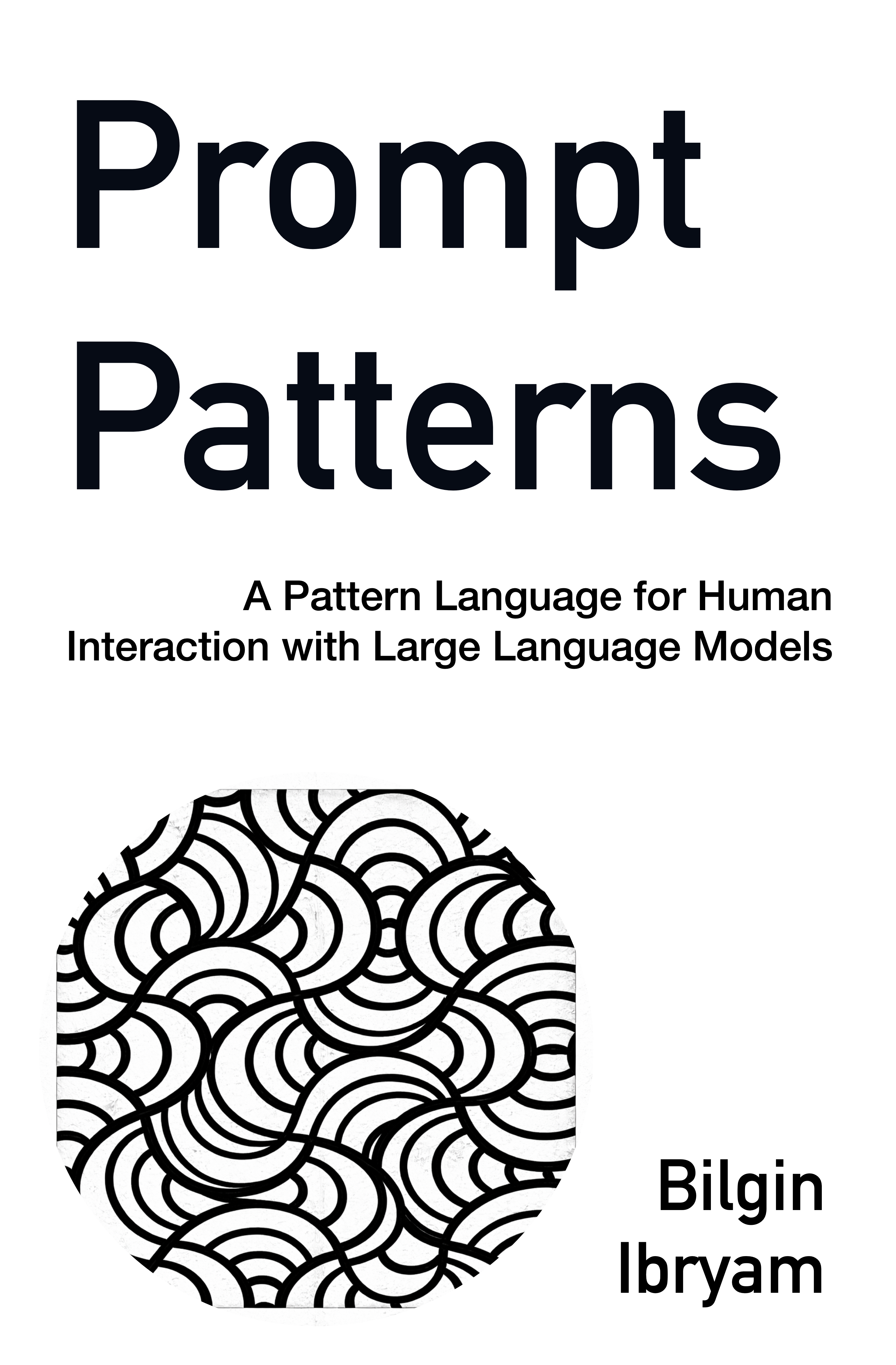
The book
Prompt Patterns
A Pattern Language for Knowledge Engineering with Large Language Models
The website gives you the names, diagrams, and one example per pattern. The book gives you the full treatment — mechanism, multiple worked examples per technique, trade-offs, placement rules, debugging sequences, and composition recipes for real prompting work.
Leanpub lets you read a generous free sample before buying. Pay what you want above the minimum.
What you get
- 27 reusable prompt patterns across 6 design categories
- 67 concrete techniques — the named, ready-to-apply moves inside each pattern
- 170+ worked prompt/response examples, with multiple per technique
- 6 underlying prompting principles with diagnostic guidance
- Mechanism explanations — why each pattern works, not just how
- Composition recipes — how patterns stack and when they collide
- Placement, sequencing, and debugging rules for real prompts
- Model-agnostic: works with ChatGPT, Claude, Gemini, and whatever comes next
Site vs. book — what changes
The site is the free public reference. The book is the teaching material. Here is the honest split:
| Per pattern | Free site | Book |
|---|---|---|
| Problem and solution | One paragraph each | Full narrative with context and nuance |
| Worked Prompt/Response examples | 1 per pattern | 6–12 per pattern (2–4 per technique) |
| Techniques | Name + one-liner | Full body with practical-use variants |
| Mechanism (why it works) | — | Dedicated section per pattern |
| Discussion: placement, scope, debugging | — | Dedicated section per pattern |
| Composition recipes | Related-pattern hints | How patterns stack and when they collide |
| Depth, roughly | ~20% of the material | 100% |
Who this book is for
Knowledge workers
Using ChatGPT or Claude daily to write, analyze, research, and decide — and wanting results that hold up without constant rework.
Engineers with Claude Code
Driving coding agents and wanting prompts that produce reliable plans, diffs, and parseable output across runs.
Team leads
Needing a shared vocabulary so team members can name, review, and reuse the prompt moves that work.
Builders of LLM systems
Embedding prompts into agents, RAG pipelines, and tools — wanting patterns that stay stable as models change.
Table of Contents
Introduction
- Prompts
- Patterns
- Principles
- Pattern Categories
- Patterns List
Part 1 — Objective Framing
- Task Directive
- Perspective Framing
- Judgment Criteria
- Constraint Scoping
- Example-Driven Specification
Part 2 — Information Supply
- Context Loading
- Context Curation
- Structural Segmentation
Part 3 — Method Prescription
- Alternative Enumeration
- Hierarchical Decomposition
- Dependency Decomposition
- Stepwise Decomposition
- Multi-Path Reasoning
- Governing Abstraction
Part 4 — Quality Validation
- Knowledge Externalization
- Deferred Commitment
- Reflective Evaluation
- Claim Enumeration
Part 5 — Output Representation
- Semantic Compression
- Response Tail
- Answer Boundary
- Output Template
- Formal Representation
Part 6 — Interaction Design
- Control Reversal
- Interpretation Grammar
- Meta Prompting
- Specification Extraction
Back Matter
- Afterword
- Resources
About the author
Bilgin Ibryam is the author of Prompt Patterns, co-author of the O'Reilly bestseller Kubernetes Patterns, and author of Camel Design Patterns. He spent the last decade writing about pattern-based software design for distributed systems, and he now applies the same rigor to prompting. You can follow him on X (@bibryam).
Ready to stop guessing with prompts?
Read the free sample first. If the pattern language clicks, pay what you want for the full book.