Governing Abstraction
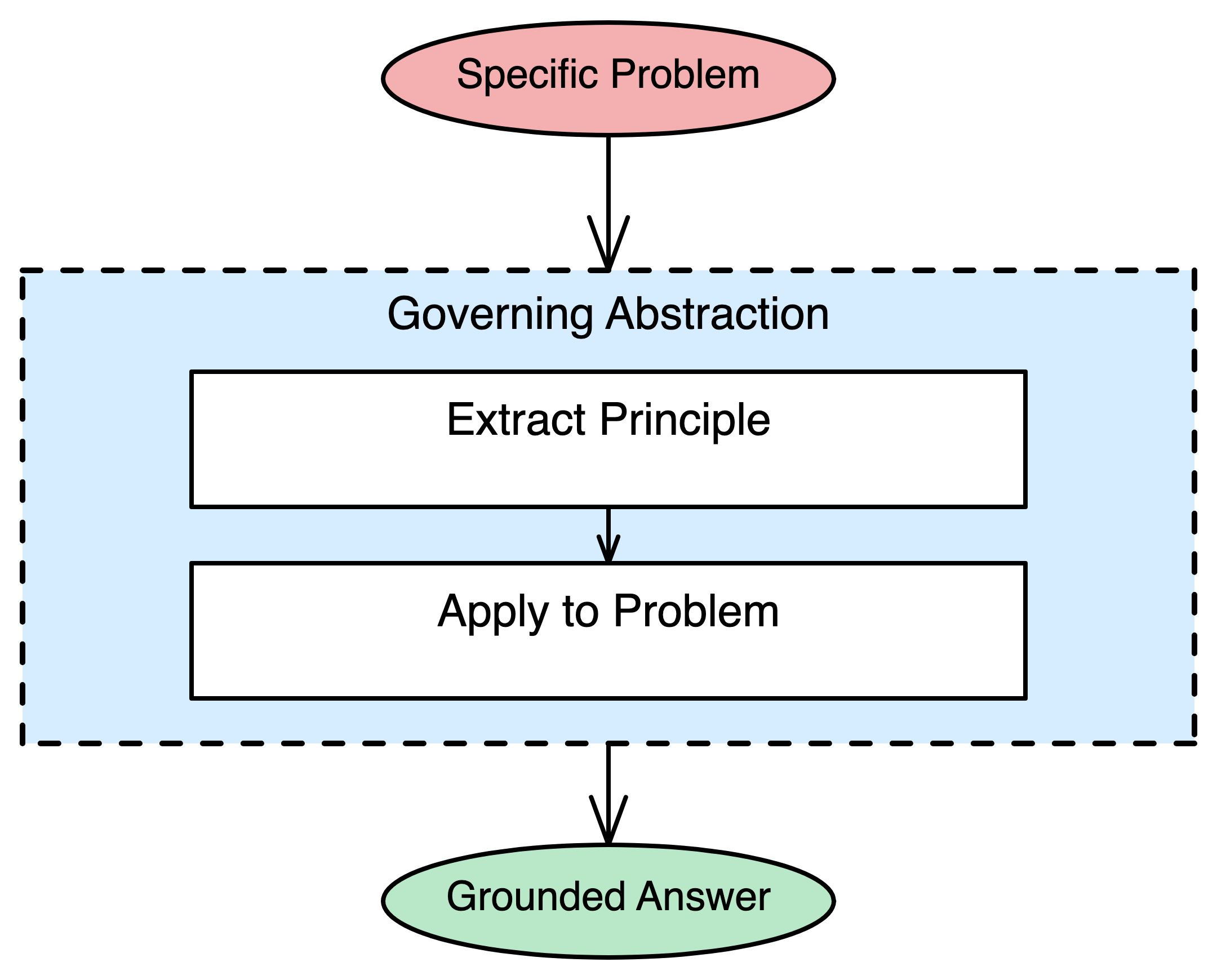
Derives a governing principle or broader frame before solving the specific instance, so reasoning proceeds from a stable abstraction rather than surface details.
Problem
Solving detail-heavy instances directly encourages surface-level manipulation and fragile reasoning that misses governing principles.
Solution
Force an abstraction step first (general question or explicit principle), then reason downward to the instance. Starting from higher-level representations constrains and stabilizes downstream inference.
Example
One worked example. The book has 2–4 per technique.
A company reported 18% revenue growth, but its stock fell 7% after earnings. Why?

Before answering, identify the financial principle that governs why positive operating results can still lead to a negative market reaction.
Then use that principle to explain the case.
Principle: Markets react to the gap between expectations and results, not to the absolute result alone. A positive result can still produce a negative reaction if investors expected something stronger.

Application: The 18% growth figure may still have been below what investors expected, or guidance may have implied slower future performance. The 7% decline reflects repricing against expectations, not simply whether growth was positive.
Techniques
Concrete ways to implement Governing Abstraction. Each technique fits a different situation.
- 01
Step-Back Questioning
Replace the original question with a more general one whose answer subsumes the instance, then use that answer to resolve the specific case.
- 02
Principle Derivation
Force the model to state the governing principle or rule explicitly before applying it to the specific instance.

Full treatment in the book
Governing Abstraction — the complete chapter
- ▸ Mechanism — why this pattern works
- ▸ 2–4 worked examples per technique
- ▸ Placement, sequencing, and debugging rules
- ▸ Composition with related patterns