Interpretation Grammar
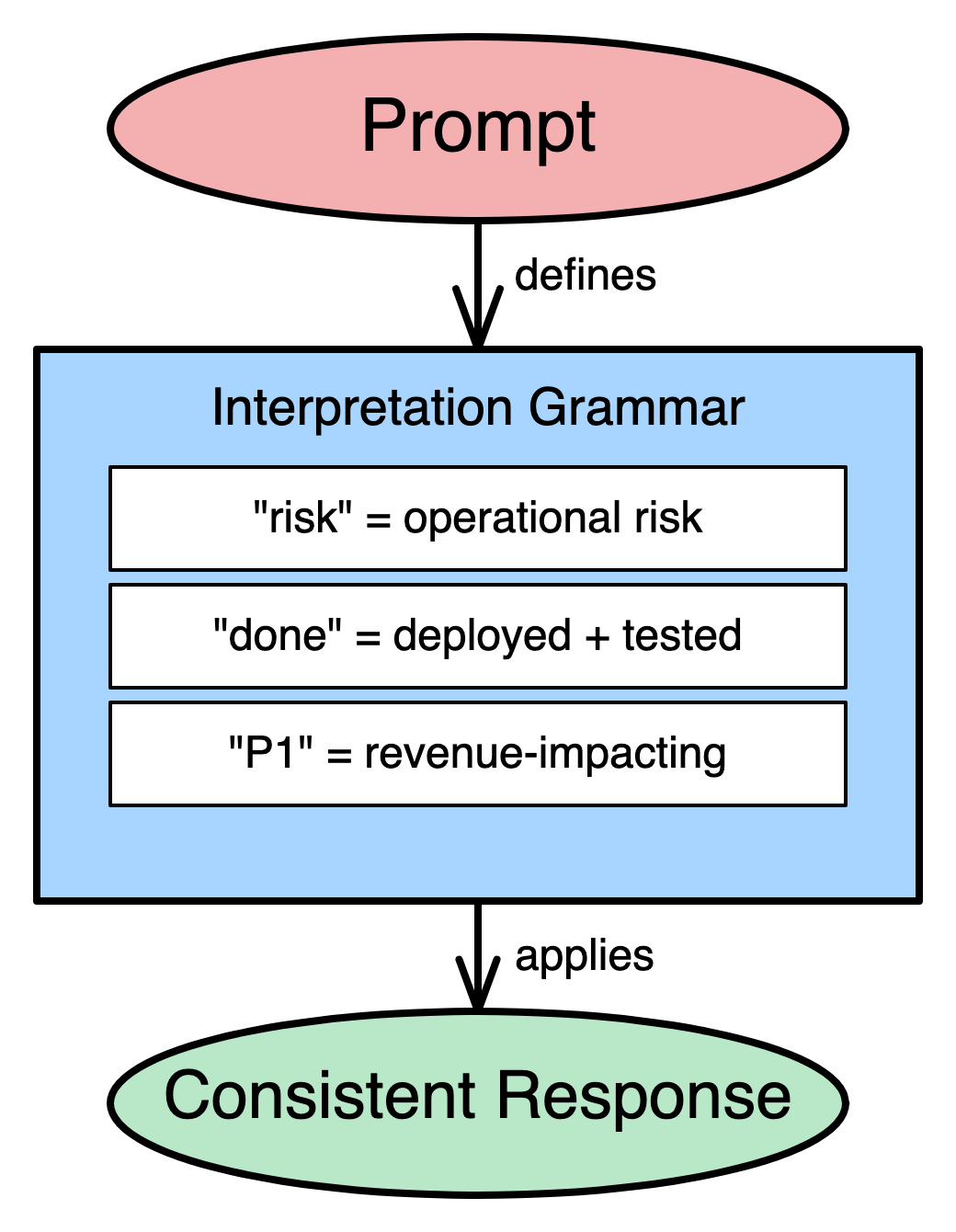
Defines explicit rules for how terms, operators, and notation are interpreted, replacing the model's inference with declared definitions.
Problem
The model infers what terms mean, what commands do, and how notation is parsed - producing plausible but inconsistent interpretations that drift across turns.
Solution
Declare explicit definitions for terms, operators, and notation that bind the model's interpretation. Replace inference with definition: precision where there was ambiguity, stability where meaning would drift, compression where verbose prose can be replaced by defined operators.
Example
One worked example. The book has 2–4 per technique.
We are evaluating deployment options for our new service.
Use the following definitions throughout this conversation:

- "Risk" means operational risk only: likelihood of downtime, security incidents, data loss, and recovery complexity.
Do not include business risk, vendor lock-in, or market risk unless explicitly asked.
- "Cost" means total cost of ownership over 3 years, including infrastructure, personnel, and maintenance.
- "Speed" means time from decision to production-ready deployment.

Evaluate Option A: managed Kubernetes on a major cloud provider.
Risk: Low.
The cloud provider handles infrastructure patching, node replacement, and control plane availability.
Downtime risk is mitigated by the provider's SLA (typically 99.95%).
Security patching is automated for the control plane.
Recovery complexity is low because the provider manages backups and failover.
The main operational risk is misconfiguration of workload-level resources, which remains the team's responsibility.

Cost: Moderate.
Estimated 3-year TCO includes compute instances, managed Kubernetes fees, networking, and storage, plus 0.5 FTE for workload management.
No hardware procurement or data center costs.

Speed: Fast.
A production-ready cluster can be provisioned in hours.
CI/CD integration with major providers is well-documented.
Estimated time from decision to production: 2-4 weeks including security review and network configuration.
Techniques
Concrete ways to implement Interpretation Grammar. Each technique fits a different situation.
- 01
Term Definition
Fix what specific words or phrases mean within the interaction so the model applies the definition as a binding constraint on interpretation.
- 02
Operator Definition
Define commands or scoring functions the model treats as instructions rather than content, creating a micro-language for repeated precise actions.
- 03
Notation Definition
Introduce symbols or shorthand with explicit semantics for encoding relationships that natural language expresses awkwardly or inconsistently.
Full treatment in the book
Interpretation Grammar — the complete chapter
- ▸ Mechanism — why this pattern works
- ▸ 2–4 worked examples per technique
- ▸ Placement, sequencing, and debugging rules
- ▸ Composition with related patterns