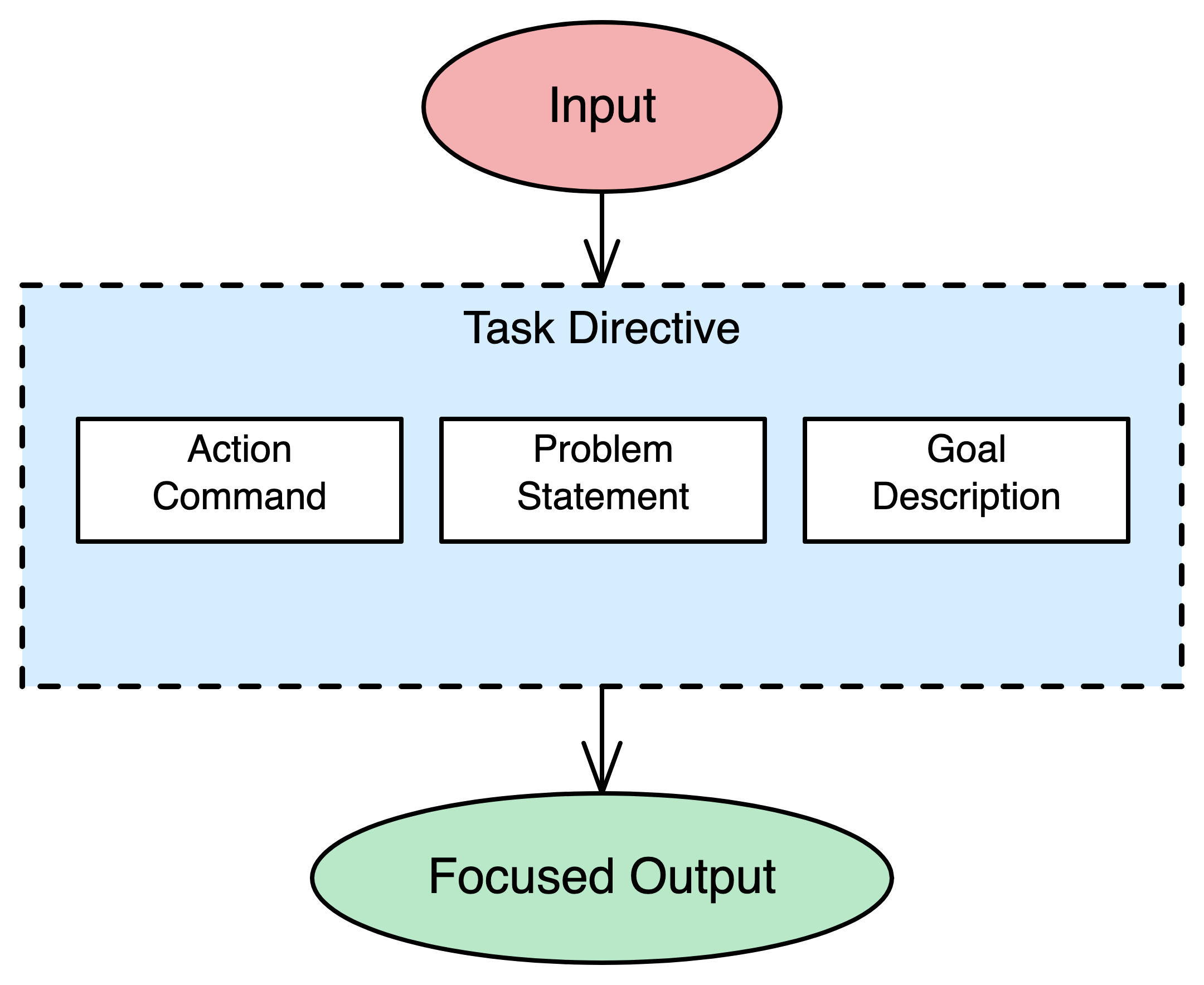
Task Directive
Defines the exact unit of work the model must perform, independently of how it must be performed.
Problem
The model is not goal-seeking by default; if the task is not explicitly named, it guesses the response type from weak cues and often solves the wrong problem.
Solution
Name the exact unit of work directly (summarize, rewrite, evaluate, extract). This high-salience task cue shifts generation toward task-shaped continuations instead of generic topic continuation.
Example
One worked example. The book has 2–4 per technique.
Rewrite the onboarding email below in clear, confident, professional language.

===

Welcome to our platform. It helps your team manage payroll and compliance in one place. We are excited to support your journey and help you get value quickly.
Welcome. Our platform helps your team manage payroll and compliance from one place. Complete your company setup to prepare your first payroll run and reduce manual work from the start.
Techniques
Concrete ways to implement Task Directive. Each technique fits a different situation.
- 01
Action Command
Use an imperative verb (summarize, rewrite, extract, generate) to execute a well-learned task directly.
- 02
Problem Statement
Pose a precise question that defines the gap to fill when you know what to resolve but not what the answer should look like.
- 03
Demonstration
Show one correct input-to-output example and let the model continue the pattern when the task is easier to show than describe.

Full treatment in the book
Task Directive — the complete chapter
- ▸ Mechanism — why this pattern works
- ▸ 2–4 worked examples per technique
- ▸ Placement, sequencing, and debugging rules
- ▸ Composition with related patterns