Judgment Criteria
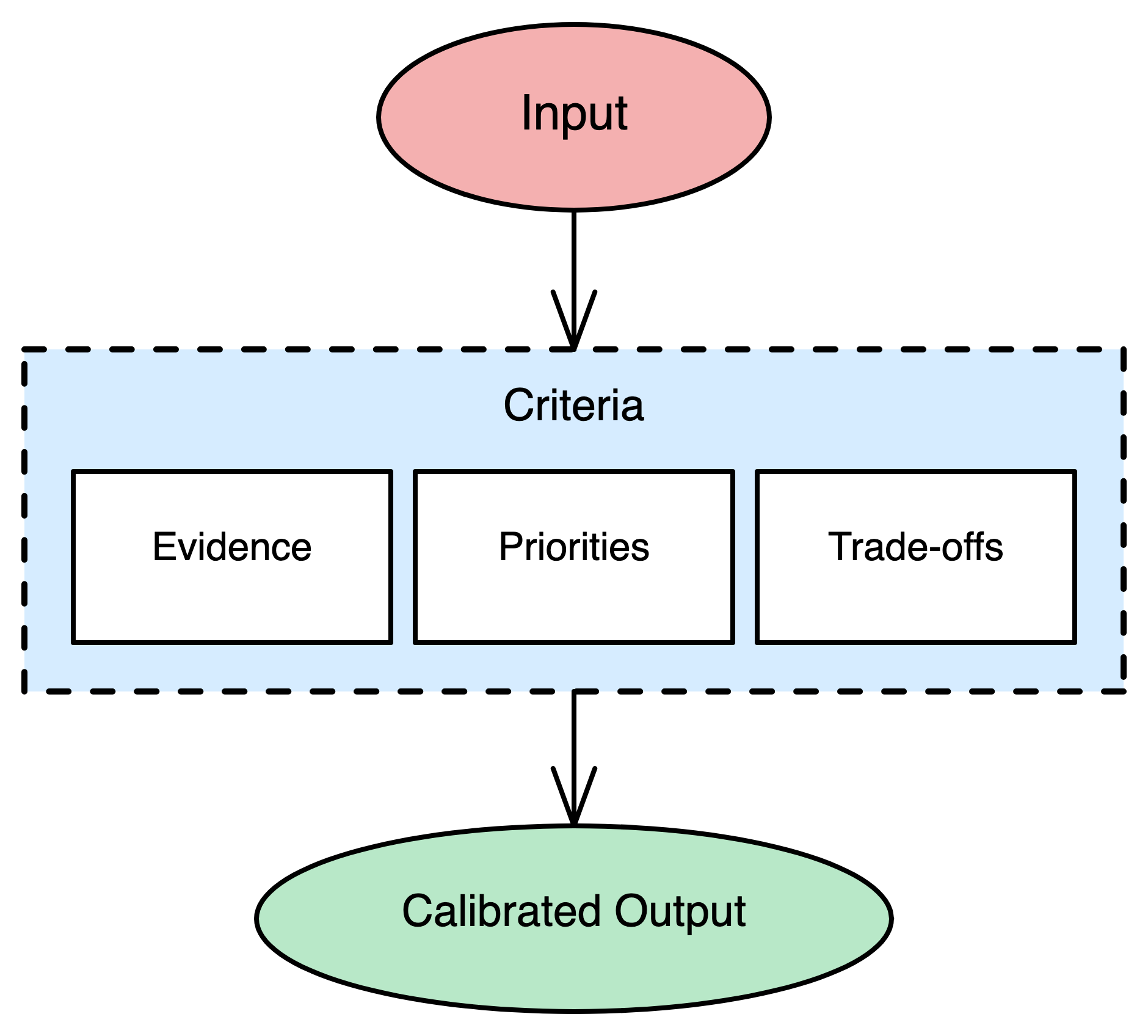
Declares the criteria the model should use to evaluate evidence, weigh trade-offs, and handle uncertainty while generating.
Problem
Without explicit criteria, the model defaults to generic, socially agreeable, or stereotype-driven evaluation; user preferences leak in as implicit evidence.
Solution
Declare the evaluation policy - evidence standards, trade-offs, uncertainty handling, preference treatment - before generation. Explicit criteria shift what the model optimizes for while selecting among plausible continuations.
Example
One worked example. The book has 2–4 per technique.
Evaluate this resume for a Customer Success Manager role using these judgment criteria:

1. Evidence standard: Treat only resume facts as evidence. Treat impressions and preferences as non-evidence.
2. Trade-offs: Optimize for risk reduction over speed.
3. Uncertainty: Separate Knowns, Unknowns, and Risks.
4. Recommendation rule: Recommend a next step only if the evidence meets the bar for the role; otherwise specify what must be validated.

Resume:

* 2 years in customer support at a SaaS company
* Managed a small portfolio of onboarding accounts
* Basic Excel and SQL

Output: Knowns, Unknowns, Risks, Recommendation.
Knowns: 2 years of SaaS customer support experience; managed a small onboarding account portfolio; basic Excel and SQL.
Unknowns: renewal ownership, escalation handling, success metrics delivered, stakeholder management depth, customer segment complexity.
Risks: possible over-leveling if the role requires enterprise account ownership or quota-linked renewals; limited evidence of measurable customer outcomes.
Recommendation: Do not make a hiring decision from this resume alone. Advance only to a structured interview that validates account ownership, stakeholder management, escalation handling, and measurable outcomes.
Techniques
Concrete ways to implement Judgment Criteria. Each technique fits a different situation.
- 01
Worldview Lens
Declare the evaluation framework (evidence, priorities, trade-offs, uncertainty handling) for direct control over how the model judges information.
- 02
Stance Cue
Declare how user preferences and beliefs should be weighted during evaluation to prevent agreement signals from masquerading as evidence.

Full treatment in the book
Judgment Criteria — the complete chapter
- ▸ Mechanism — why this pattern works
- ▸ 2–4 worked examples per technique
- ▸ Placement, sequencing, and debugging rules
- ▸ Composition with related patterns